
Digital scrapbook
Clearing out my tabs! Come have a look into my mind :eyes:
For the past few months, I’ve been trying to force myself into creation-mode, when in reality, I think I’m still in composting-mode. I have many ideas. I have lots of plans. But it just doesn’t feel like the season to actually enact them. Drafts are on pause while I figure them out and find or create the right words and energy to give them. Until then, here’s just some stuff I’ve found interesting on the internet. In real life, I stumbled upon a university magazine which is so DIY and Gen-Z that it’s astounding and resolutely inspiring. Way to go, Binghamton Review. Also, in real life, I was trying to dig up old flower bulbs to move them into the new garden and found that they were rotten! They looked and felt like huge squishy maggots. That’s what I get for not taking them out before winter. Nevertheless, it’s been refreshing to get outside more in the beautiful spring weather, and I hope that fellow Northern Hemisphere folks are basking in the sunshine. And if spring/summer isn’t your season, I feel you. Sometimes the energy that comes with more sun light makes me feel anxious and frantic, so I’d rather stay put and read. If you’re like that too, then here’s a bunch of stuff for you to enjoy. I think the essay by Samantha Hunt is my favorite.
Banner image: Adams Mansion, Quincy, Mass. Photographer: Abdalian, Leon H. Date: October 10, 1929 https://ark.digitalcommonwealth.org/ark:/50959/f7623d86d. I wish my house/garden looked like this! Maybe one day!
The listening gift, Aeon
“It is the dark matter of conversation, the white space around a poem. For Rilke, listening is receiving the divine.”
The idea that listening might be a gateway to a kind of transcendence is echoed in a ‘sound’ reverie that Rilke presents alongside his school story. At one time, he says, he spent ‘many hours of the night’ in the company of a skull borrowed from an anatomy class, imagining what he might hear if only he were able to pass a phonograph needle over the grooves in its coronal suture. This auditory fantasy kept coming back (‘a recurrence which has taken me by surprise in all sorts of places’), and it made Rilke consider the visual bias of the European poet: ‘sight overladen with the world – seeming to dominate him constantly; how slight, by contrast, is the contribution he receives from inattentive hearing’, a critique that might have been self-reflection.
A Defense of Weird Research, Astrisk Magazine
“Government-funded scientific research may appear strange or impractical, but it has repeatedly yielded scientific breakthroughs — and continues to pay for itself many times over.”
And so there are scientists who study frog skin or become experts in the sex lives of flies. But that frog skin led to a new theory of rehydration, and ultimately the invention of oral rehydration therapy, which has saved over 70 million lives — most of them children. The sex lives of flies? Well, understanding how flies reproduce led to the development of a sterilized screwworm fly and the elimination of a common livestock pest, saving some $200 million a year.
The applications of basic science are often unexpected because new technologies can be broadly applied. NASA was certainly not trying to develop better vacuums when they invested in research on batteries — yet the result was the Dustbuster. NASA-funded research is also responsible for the fundamental developments behind LASIK eye surgery (laser research), TempurPedic mattresses (materials research), and even Astroglide (initially developed as a substance to improve heat transfer). These important (or, at the very least, useful) technologies all relied on doing basic science first.
Of course, none of this happens overnight. It often takes decades for something to go from “science” to “a new technology.” But basic research is necessary to get to a stage where funding the development of a piece of useful technology, or the clinical trial of a new drug, is even possible.
We should all pay attention to what is happening at the National Archives, LinkedIn
“On Friday night, the president officially fired the Archivist of the United States, as he had promised to do before taking office.”
THIS IS JUST A BIG YIKES/10 FOR ME!!
So far, with everything else going on, this has hardly registered in the top news stories. It is important to know that none of this is normal. No Archivist of the United States has ever been fired by a president, in almost 100 years since the position was created, making Shogan—the first woman in the office—the shortest serving AOTUS. This is an apolitical position, even when the officeholder was appointed by the previous president. The statute regarding the office of the Archivist of the United States (44 USC § 2103) reads: "The Archivist shall be appointed without regard to political affiliations and solely on the basis of the professional qualifications required to perform the duties and responsibilities of the office of Archivist."[6]
Regardless of your politics, failing to defend the independence National Archives and its staff right now—and allowing it to be gutted or turn political—could be disastrous for the future of democracy.
From “walking in the desert” to Escaping Flatland, Psychology of Ambition
Henrik shifted his lifestyle to be able to write more. As he developed competencies and had material success in his non-writing work, he would “spend” that capital, both the literal monetary capital and his increased credibility with his employer, on working less and writing more. (More on that in Henrik’s essay: 6 lessons I learned working at an art gallery.)
“What I did concretely was that I gradually lowered the amount of hours I worked. For the last two years, I’ve worked 20 hours a week whenever I wanted to write. That was my deal. Like, I traded all of my increased income toward just having more and more ridiculous demands on my employer. By being more agentic, I became so valuable to them that I could have these ridiculous demands, and that meant I could write.”
Now—as of a few months ago, and two years after finding his first glimmer of signal—he can support himself and his family solely with his writing.
Related:
Contemplation as Rebellion, New Cartographies
Even as I find Sacasas’s essay inspiring, I find it troubling. The way he frames the contemplative gaze as a means of re-enchantment makes me uncomfortable. An enchanted world is, by definition, a world that presents a false front to us — a front composed of what Sacasas terms, at the end of his essay, “mere things.” To see what’s really there in an enchanted world, you need to see beyond or through the surface. You need to discover what’s hidden, what’s concealed, by the merely material form, and that requires something more than sensory perception. It requires extrasensory perception. In this framing, the contemplative gaze is not just unlocking what lies untapped within us — the powers of perception, imagination, interpretation — but also exposing some spiritual essence that lies hidden within the object of the gaze.
The issue I take with Sacasas’s essay is not a matter of sense — I’m pretty sure we’re talking about the same perceptual phenomenon — but of wording. When he suggests that “enchantment is just the measure of the quality of our attention,” he’s muddying the waters. When we look at the quality of attention demonstrated by Heaney, Muñoz, and Hawthorne, we’re not seeing enchantment. We’re seeing an exquisite openness to the real. A sense of wonder does not require a world infused with spirit. The world as it is is sufficient. The reason the wording matters here is simple. What bedevils our perceptions today isn’t a lack of enchantment. It’s a lack of reality.
What Does a Science Writer Do, Anyhow?, LinkedIn
I didn't want to sell widgets — I wanted to continue to be of service to the public.
Science journalism has been eroding for decades, a victim of the exigencies of the news business. Trust in science has also taken a hit in recent years, especially among right-leaning Americans.
With far fewer journalists (especially locally) covering science, many organizations that do a lot of research have had to become their own mini-outlets, sharing news of discoveries and innovations directly with the public and the wider world.
…
The most obvious part of my job — talking to scientists and turning those conversations into articles — is really only half of what I do.
A big part of the role is helping to decide what to cover in the first place. At my current organization, our physicians and scientists publish more than 2,000 studies annually. Between regular articles and short briefs, our small team of writers can cover around 100 studies a year (less than 5%).
Picking the truly great stories out of a sea of good stories is a challenge — and a skill!
Legacy of the angels, Aeon
“When medieval scholars sought to understand the nature of angels, they unwittingly laid the foundations of modern physics.”
This radical rethinking of Aristotelian physics, catalysed by medieval debates in angelology, allowed a new understanding of the relationship between bodies, place and motion that helped reformulate our understanding of the very fabric of the cosmos. For Aristotle, motion was just inherent to bodies because bodies had natures that made them seek their natural place. To posit angels as immaterial external forces was indeed oddly closer to a classical physics that sees an invisible force like gravity working on bodies externally. In fact, Gottfried Wilhelm Leibniz accused Newton of having introduced occult forces with his theory of gravity, because gravity seemed to be a supernatural force acting on bodies at a distance.
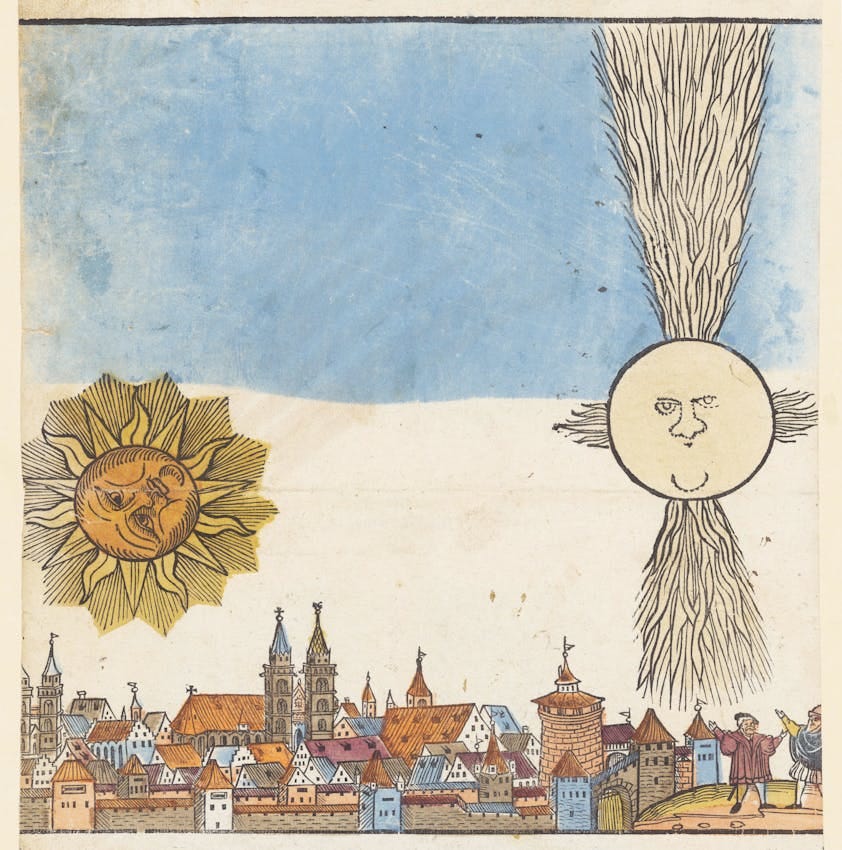
Related: https://publicdomainreview.org/collection/celestial-phenomena-16th-century-germany/
Samantha Hunt on the Wild Delirium of Loving Language, LitHub
The sun will set soon. Birds come to the feeder. Each bird is magnificent. Each bird is weird. How did the birds get so weird? A bright red head, spiky tufts, yellow eyes, pink feet, hidden fluorescence, the ability to fly. How did the word “weird” get so weird? And my hands, they are also weird. I’m watching the weird world, the weird birds when a thought arrives from nowhere. What if I’ve been dead for a long time? What if I’ve been dead my whole life? If I am dead, the strangeness of existence is momentarily comprehensible. I catch a glimpse or scent of our dispersed worlds, this place without border, boundary, pain, or punctuation. This place where we are all intimately mixed up with one another. My branch, your book. His leg, her light. All the elements my body and your body have known: a mountain boulder, sediment in the sea, an underground pebble, sand. Everything is ancient, small, and eternal. More birds arrive. More birds leave. My children are playing in the yard. They jump, shriek, and pretend to be something other than their current forms. I hear them speak and, as if waking, my specifics come to collect my body back into being a mother, sister, daughter, wife, friend, a woman who is alive, reading a book outside before dusk. In the yard, I shake off enough deadness to go make dinner. My arms feel stronger with the memory of the rocks that make me.
…
After the word “god” became the word “love,” rocks became books, and books rocks. It makes sense to me. The longer I live with books and words, the more I enjoy their erosion. I break them open. I make beaches. And, as my grandma did, I reinterpret meanings. The older I get, the solid rock books of my youth make room for a literature that’s more like the trees, so much greenery and decomposition. I confuse which book is which and what chapters belong where. Books composed in the hope of also one day being decomposed. Life and death in the library of trees. Death as a library. Library as a forest.
Folk search engines, Escape the Algorithm
We don’t need a better large search engine. Instead, we need to cultivate what I would call “folk search algorithms,” a set of tools and practices that, whether by chance or design, are not influential enough to move markets.
Related:
The Critic as Friend, Yale Review
The wisest commentators understood that at issue was the problem of authority. Who granted the critic the power to judge? What justified his judgments? In his 1750 essay for The Rambler, “An Allegory on Criticism,” Samuel Johnson attempted to answer these questions by imagining Criticism as a shining and virtuous demi-goddess. The eldest daughter of Labor and Truth, Criticism was raised by Justice in the palace of Wisdom, where she learned from the Muses the ancient rules of tragic and comic drama: the unities of action, time, and place; a sense of proportionality and balance. When Criticism came of age, she was given a scepter by Justice, one end of which was bright and the other dark, and a torch by Labor and Truth. By the light of her torch, she could perceive the beauties and the faults of all manmade objects. With the bright end of her scepter, she could consign what was harmonious and true to immortality. With the dark end, she destroyed whatever appeared twisted and false.
…
In the burgeoning print public sphere of the late eighteenth and nineteenth centuries, more species of critics emerged than Johnson’s flatterers and malcontents. They sought shelter in institutions like reviews and monthlies. They cloaked themselves in the noblest and most winning guises they could contrive. Some elaborated a philosophy and a practice of criticism that enabled the spectator to “judge in the same spirit in which the Artist produced,” the poet Samuel Coleridge wrote in his 1814 treatise “On the Principles of Genial Criticism in the Arts.” Others modeled an appealing temperament or an ethos that one could cultivate through criticism: the cool, abstracted discrimination by which one could “reconstruct the fragments” of a painting or a novel “into a whole,” George Eliot wrote in an 1868 essay; or “the power of being deeply moved by the presence of beautiful objects,” as Walter Pater described criticism a decade later, in a language of hot, panting communion between the critic and the work of art. Still others opted to ally the critic not with an ethos but with a profession. John Addington Symonds, in his 1900 essay “On Some Principles of Criticism,” suggested that one could think of the critic “as judge, as showman, and as scientific analyst.” “The true critic,” he wrote, “must combine all three types in himself, and hold the balance by his sense of their reciprocal relations.”
The Book
“In The Book, Keith Houston reveals that the paper, ink, thread, glue, and board from which a book is made tell as rich a story as the words on its pages. In an invitingly tactile history of this 2,000-year-old medium, Houston follows the development of writing, printing, the art of illustrations, and binding to show how we have moved from cuneiform tablets and papyrus scrolls to the hardcovers and paperbacks of today.”
Want want want!
memory through metamorphosis, talyssa's digital garden
This is my absolute favorite scientific publication by Douglass J. Blackiston, et al.. It basically found that memories acquired by moths in the larval state can be retained after metamorphosis— particularly, responses to negative stimuli (an electric shock following exposure to an unpleasant odor).
So then what does this imply?
Well for the science, it means that the reduction of an organism into biological sludge does not mean complete reset and rebirth. And for people who use insects for their main model organism, it means that particular biases might need to be accounted for when working across the span of developmental periods.
But what does this mean mean?
Well we’re not bugs… so take this musing from me as a regular person, not a scientist; complete reconstruction of our tangible being fails to erase the memories (and therefore response behaviors) we’ve acquired in past iterations of our selves
Isn’t that kind of poetic?
So this study was published in 2008, and I think I saw it on tumblr (of all places) in 2012 or so (waaaaay before I even imagined myself pursuing a career in science). But the implications of this experiment invoke something spiritual in me and I have yet to put it all in words. I’ve tried writing full on essays or blog posts on this topic to no avail because I feel like I need to get my thoughts down exactly as I feel them… and to be honest, I don’t know how to feel. For now, I’ll leave you with this, and when the time is right, I’ll revisit.
Is riso ruining zines?, Papereaters
the shift away from the classic, cheap, black-and-white photocopied zine is driven by frustration with social media platforms, and a hunger for in-person connection—perhaps exacerbated by COVID-19 lockdowns. In a digital age, communities that remain invested in print are perhaps even more invested in materiality than in the past, increasing the production value of the average zine. As Bobrow puts it, “the option to post [countercultural] ideas on the internet recontextualizes the choice to print them on paper.”
…
Today, 90% of zines start their lives as a digital file of some sort that gets printed (not copied). Someone could make zines for years without ever touching a copier … and actually, that’s pretty par for the course. It seems like photocopiers should be pretty self-explanatory, but based on the kind of questions we get during Open Copy, plenty of prolific zinesters have actually never used one before.
On top of tightly controlled access to a dwindling number of copiers, photocopies are no longer the cheapest DIY printing method. In some circles you’ll hear the accusation that riso printing is kind of ruining zine fests.
…
Ultimately, I believe the shift from “classic” black and white photocopied zines to riso and full-color digital printing is a fairly organic one, driven by a number of factors. It’s not an overwhemingly positive or negative change; overall, it’s a change I feel pretty neutral about.
… every dollar we’ve earned from selling zines has been spent on printing zines for our press and other zinesters (often at a break-even rate), collecting zines, hosting a zine fest, and opening a community print shop. If that’s what it means to be a sellout then I guess I’m proud to be one. If you order our publications, ask us to speak at a college, hire us to teach workshops, or acquire zines at a markup for a non-circulating collection, know that it directly funds the work of community-based publishing. We also do plenty of free printing for a cause, devote so many (too many?) unpaid hours every year to fest organizing and running a space, and circulate plenty of free copies of our work. But if we gave all our work away for free or it always lost money or we had to stick to small print runs that could be stolen from the copier at work, we simply couldn’t make and distribute very much of it … and one of the reasons we publish (rather than, say, make paintings) is that we have something to say and we want to be read. We believe in audiences and multiples and we are interested in being a little ambitious in how widely we distribute, even if at the end of the day our “press” is just two people and a copier in their living room. This approach is not 100% punk (and neither am I). But I’m suspicious of rigid approaches to printing and publishing.
What’s your community style? the examined family
It inspired me to create this list of questions as a sort of reflection starter pack to pursuing the community of your dreams (and one that can show up for you in times of personal and political nightmare!)…
Childhood: What was your experience of community in childhood? Did your caregivers welcome people stopping by? Did they encourage connections with neighbors? Were you part of a religious community and what did that teach you (for some, it modeled mutual aid, for others, hypocrisy and performance!)? Were you an only child who got a lot of alone time and loved that, or were you surrounded by siblings and craved a quiet moment?
Culture: What is your cultural background and how do you think that shapes your ideas about community? Do you like the way it has influenced you or would you rather unlearn some of the hallmarks of how your extended family thinks about community (or doesn’t)? Do you have ideas about how clean things to have to be in order to have people over? Do these ideas differ from the ones your partners, kids, roommates hold?
Personality: Do you crave more solitude or more sociality in your daily life? Are you someone who works well without interruptions, or do you prefer co-working and the comforting noise of a busy cafe? When do you notice yourself tapping out on social settings? When do you notice yourself feeling lonely and wanting more social stimulation? What’s your appetite for creating community with people who are unlike you, irk you, or test your patience?
Space: What is your house like and does it lend itself to connection with family, friends, neighbors? Do you have places where you can gather people if you want to? What is the density like in your neighborhood? Does it lend itself to connection or does it feel like you have to really make an effort to connect with those you live proximate to?
Schedule: How much of your time is spent in a physical work place? How much of your work time is spent socializing vs. working alone? How does that jive with your personality and desire, or lack thereof, for more social connection? How busy are you and how does this impact your ability to connect spontaneously with friends or neighbors?
Economics: Do you live under capitalism? Does it force you into working more hours than you would like, and therefore not investing as much as you would like in community? (Likely a YES for everybody!) What’s your relationship to private versus shared solutions - like would you be up for sharing a lawn mower or a grill or even a pet? What feels important to you to own and what could you imagine enjoying sharing?
Crises: Do you think much about the fact that we are facing down multiple crises—environmental, political etc? If you do think about it, what do you do to prepare for potential disaster and how much of that preparation is collective? (Hint: a lot of it should be! The communities that fare best during disaster are those that are tight knit before one strikes!) How much are you already practicing mutuality in your neighborhood so that you will have solid muscles for it when things become urgent?
Why I am building Arcadia, Medium
What made research fun was the chance to uncover knowledge about something totally new, share this with others, and hopefully make it useful to the world in some way. This became increasingly difficult as I advanced in my career, as so many processes that we layer onto our science in the name of rigor and intellectual freedom (i.e., journals, grants, tenure) largely do not serve those functions. Instead, they add drag to creativity, encourage specialization over exploration, introduce gatekeeping, and even contribute to toxic work environments. For me, they began to dim the childlike magic that started it all.
…
I am not interested in “competing” with academic science. We want to work alongside it. I deeply believe in the importance of academic institutions and publicly funded pursuit of knowledge. However, we often lose sight of the true core mission of academia — education. I know countless faculty who see education as a nuisance that takes time away from the research they really want to do. For me, the education mission is what makes being a professor special. Undoubtedly, the part I will miss most are those special joyous moments I get to share with people in my lab when they have a hard-earned breakthrough, changing something about how they see the world and themselves.
By diversifying and expanding outside research opportunities we can enable academia to prioritize education more effectively. We need those most passionate about teaching to stay focused on mentoring the next generation. Arcadia will pursue research efforts that are inherently distinct from those in academia, such as higher-risk pilot projects and the often unglamorous and invisible art of tool building. New tools could light a spark for everyone’s exploration. Knowledge and lessons learned will be shared with the broader scientific community, which will hopefully, as Prachee likes to say, “lift all boats.”
research as leisure activity, personal canon
Research as a leisure activity includes the qualities I described above: a desire to ask and answer questions, a commitment to evidence, an understanding of what already exists, an output, a certain degree of contemporary relevance, and a community. But it also involves the following qualities:
Research as leisure activity is directed by passions and instincts. It’s fundamentally very personal: What are you interested in now? It’s fine, and maybe even better, if the topic isn’t explicitly intellectual or academic in nature. And if one topic leads you to another topic that seems totally unrelated, that’s something to get excited about—not fearful of. It’s a style of research that is well-suited for people okay with being dilettantes, who are comfortable with an idiosyncratic, non-comprehensive education in a particular domain.
As a result, research as leisure activity is exuberantly undisciplined or antidisciplinary. In academia, you receive specific training in a narrow field of specialization, which creates certain opportunities for your work and forecloses others. Most notably, it discourages a certain form of dilettantism—peering into an adjacent field that you don’t have the “right” background for, using techniques you aren’t “qualified” to be doing, introducing references and sources that are nontraditional and even looked down upon in your primary field. Research as a leisure activity isn’t constrained by these disciplinary fiefdoms and schisms. Any discipline can offer interesting ideas, tools, techniques.
Research as leisure activity involves as much rigor as necessary. In this style of research, certain academic practices—like extensively footnoting a written work, getting IRB approval before surveying actual people—can be ignored. This might make research as a leisure activity less rigorous and “scientific”…thoughAdam Mastroianni, in his post “An invitation to a secret society,” offers a few arguments for why professional science is also limited, and sometimes (often?) produces unrigorous research as well.
Who is doing this kind of research as leisure activity? Artists, often. To return to the site that originally inspired this post—I’d say that the artist/designer/educator Laurel Schwulst uses Are.na to develop and refine particular themes, directions, topics of inquiry…some of which become artworks or essays or classes that she teaches.
People who read widely and attentively—and then publish the results of their reading—are also arguably performing research as a leisure activity. Maria Popova, who started writing a blog in 2006—now called The Marginalian—which collects her reading across literature, philosophy, psychology, the sciences. Her blog feels like leisurely research, to me, because it’s an accumulation of curious, semi-directed reading, which over time build up into a dense network of references and ideas—supported by previous reading, and enriched by her own commentary and links to similar ideas by other thinkers.
and finally…